My collection of Dystopian imagery procedes apace, and continues to be added to:
http://pinterest.com/quietuus/dystopia/
I will start on the Utopian collection as well at some point, but I need to think of appropriate sources to use. There are very few movies and television programs that feature unambiguous utopias, though apparent utopias may also be ok for the purposes of purely visual research.
Even at this stage, there is a clear trend for imagery (facelessness, repetition, maze-like environments) and colours (drab, dark, washed out). More will surely continue to emerge.
Sunday, 14 April 2013

Friday, 5 April 2013
Update on progress.
On February 13th, I set myself a plan of action for the next month, none of the points on which have as yet materialised. This has been for a number of reasons, however, I still plan to enact all these points as building blocks towards the final project. I think, from now on, I shall do something that I should have learned from Vectis, and stop setting myself deadlines that may become an embarrasment in the future.
Wednesday, 3 April 2013
Face of Tomorrow
Tinkering around on the internet this morning, I came across this image, presented as having been created by 'scientists', overlaying faces to find the average of various countries.

The way this image has been composited has some obviously problematic elements. The fact that the taboo against race mixing has been preserved by treating white Americans and black Americans as separate, whilst reducing the entirety of West Africa to a single face jumps out as a particularly egregious example. Some quick research, however, shows that this project was not done by scientists, and the image above is obviously assembled from a variety of sources, though all apparently by the same art, Mike Mike. A native of Capetown, currently living in Istanbul, Mike's website describes the project thusly:
It deals with notions of race, place, identity and belonging on both an extremely local level as well as on an impossibly ambitious, almost Borgesian, global scale. The project is an exploration of human identity as affected by the forces of globalization and makes full use of all the tools of the modern economy – distributed work across several time zones, outsourcing to take advantages of cost disparities, an open source model that allows input from contributors, and of course the internet itself as a medium of display and exchange. Mike travels the world photographing in each city the first one hundred people he can convince to take part in his project. He then combines the faces to create one new male and female individual, which for him is a distilled representation of that place at a future moment in time.
These images are interesting to me partly because of their aesthetic qualities, their slight ghostliness and immateriality that reminds me of John Berger's description of the work of William Blake in Ways of Seeing: "he did everything he could to make his figures lose substance, to become transparent and indeterminate one from the other, to defy gravity, to be present but intangible, to glow without a definable surface, to be not reducible to objects." The work is also interesting in its relation to the humanist traditions of western art, particularly, for example, the idea expounded by Albrecht Durer, that an ideal nude figure should be composed of only the most 'ideally' proportioned components of a range of real figures. These images use a more modern, photographic form of synthesis, but seem to relate to similiar concepts, adding another layer of political meaning, though it is worth noting that the artists aims are towards realism as opposed to idealism. However, the individual people are still obscured by the artistic process. I find this emblematic of one of the key problems that pervades 'utopian' political and social thinking; how to simultaneously value the individual whilst recognising the needs of the collective. Finding ways of synthesising different points of view or conceptions together, either to highlight their similarities or to expose their differences is, I think, something that will need to be explored in this project. One of the most fundamental aspects of the thing, and one I am considering strongly as I try and envisage a form to work towards, is the fact that Utopia/Dystopia is not a dichotomy, but a continuum of viewpoints. One person's heaven is another person's hell.
Monday, 1 April 2013
Anti-Surveillance Clothing
An article on the Guardian website caught my eye today:
http://www.guardian.co.uk/artanddesign/2013/mar/31/anti-drone-hoodie-big-brother
This piece explores the work of Adam Harvey, an artist/fashion designer who creates clothing, make-up and accessories that are designed to counter surveillance technology. An interesting artifact of our post-9/11 panoptic dystopia.
I am continuing with two large essays, and have made some tentative decisions about the layout and contents of the book (I think, at the moment, that it will only be one book.) I need to make a few models to map out the number and layout of the quires and other matters. I have also made a small one-off book, which I will post photographs of (hopefully) later today.
http://www.guardian.co.uk/artanddesign/2013/mar/31/anti-drone-hoodie-big-brother
This piece explores the work of Adam Harvey, an artist/fashion designer who creates clothing, make-up and accessories that are designed to counter surveillance technology. An interesting artifact of our post-9/11 panoptic dystopia.
I am continuing with two large essays, and have made some tentative decisions about the layout and contents of the book (I think, at the moment, that it will only be one book.) I need to make a few models to map out the number and layout of the quires and other matters. I have also made a small one-off book, which I will post photographs of (hopefully) later today.
Wednesday, 20 March 2013


Tuesday, 19 March 2013
Potential Sources
A list of literary works to consider, grouped loosely under the headings of Utopia and Dystopia:
Jorge Luis Borges - Tlön, Uqbar, Orbis Tertius
Margaret Cavendish - The Blazing World
Robert Heinlein - For Us, The Living
Plato - The Republic
Thomas More - Utopia
Franci Rabelais - Gargantua
B.F. Skinner - Walden Two
Henry David Thoreau - Walden; or, Life in the Wood
HG Wells - Men Like Gods
Tao Yuanming - The Peach Blossom Spring Story
Ray Bradbury - Fahrenheit 451
John Brunner - The Sheep Look Up
Philip K. Dick - Flow My Tears, The Policeman Said
E.M. Forster - The Machine Stops
Aldous Huxley - Brave New World
Franz Kafka - The Trial
Ursula K. LeGuin - The Lathe of Heaven
Alan Moore - V For Vendetta
George Orwell - 1984
Yevgeny Zamyatin - We
UTOPIA
Francis Bacon - New AtlantisJorge Luis Borges - Tlön, Uqbar, Orbis Tertius
Margaret Cavendish - The Blazing World
Robert Heinlein - For Us, The Living
Plato - The Republic
Thomas More - Utopia
Franci Rabelais - Gargantua
B.F. Skinner - Walden Two
Henry David Thoreau - Walden; or, Life in the Wood
HG Wells - Men Like Gods
Tao Yuanming - The Peach Blossom Spring Story
DYSTOPIA
Margaret Atwood - The Handmaid's TaleRay Bradbury - Fahrenheit 451
John Brunner - The Sheep Look Up
Philip K. Dick - Flow My Tears, The Policeman Said
E.M. Forster - The Machine Stops
Aldous Huxley - Brave New World
Franz Kafka - The Trial
Ursula K. LeGuin - The Lathe of Heaven
Alan Moore - V For Vendetta
George Orwell - 1984
Yevgeny Zamyatin - We
Saturday, 16 March 2013
The Vision and the Void
To begin my research I have taken a few books out from the University library that seemed broadly relevant to the topic. The first of these that I will write about, and probably the one that has inspired the most in-depth response from me in relation to its length, is:
Manley, R. (1998) The End is Near!: Visions of Apocalypse, Millenium and Utopia. Los Angeles: Dilettante Press. ISBN 0966427270
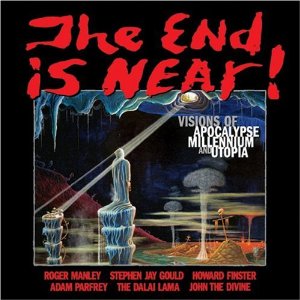
This book is essentially a catalogue of an exhibition held at the American Visionary Art Museum in Baltimore from May 1997 to May 1998. The exhibition focused mainly on 2d work, particularly paintings, and thus misses out on the entire outsider genre of Visionary Environments, which are very relevant to the Utopia/Dystopia project, as they often represent concrete attempts to actually create a perfect world, rather than simply offer a window to heaven or hell.
As with all outsider art or 'art brut' that finds its way, by whatever means, into the fringes of the 'official culture' ( of which museums, books held in university libraries must be held to be a part) there are a lot of uncomfortable questions to be asked here about prurience, the romanticisation of mental illness, and good old fashioned exploitation. Some revel in this; the book includes an essay by Feral House's Adam Parfrey, a man who in his gleeful revels in the dark underbelly of culture has ended up dedicating his life to the confused (and so stereotypically right wing American) belief that being extremely reactionary is the same as being radical. A failure to recognise that some extremists beliefs are not so much outside the American mainstream as tributaries of it; that it is much more common to see a right wing extremist on television than it is a left-wing artist, for much the same reason it is more common to see a ufologist or an alternative therapist than a bona fide scientist. There is a suggestion in Parfrey's essay (which is, admittedly, balanced out with none other than the Dalai Lama) that, by not criticising the bizarre fundamentalist, sexist and racist beliefs that drive many of the artists featured in this book, that they have been given fair treatment which society has denied them. Like the Manichean narratives of the apocalypse artwork, this tries, like many less sophisticated counter-cultural visionaries, to construct a worldview in which everything that is 'official' is bad and everything that opposes the official is good. All others ethics are swept to one side, and though people like Parfrey claim to simply be showing hard truths that others would like to ignore, in fact they present a cartoonish worldview, defined by that which they claim to oppose in much the same way that Satanism is defined by Christianity, and act as legitimisers for neo-fascists, fundamentalists and other unpleasant extremists.
Subscribe to:
Posts (Atom)